When families start looking for alternative education options, they’re often already deep in a problem. Something isn’t working. A child is frustrated, disengaged, bored, anxious, or falling behind. The instinct—understandably—is to jump straight to a solution: a different school, homeschooling, a learning center, online classes.
But real problem solving doesn’t start with solutions. It starts with clarity.
At its most basic, a problem can be described like this:
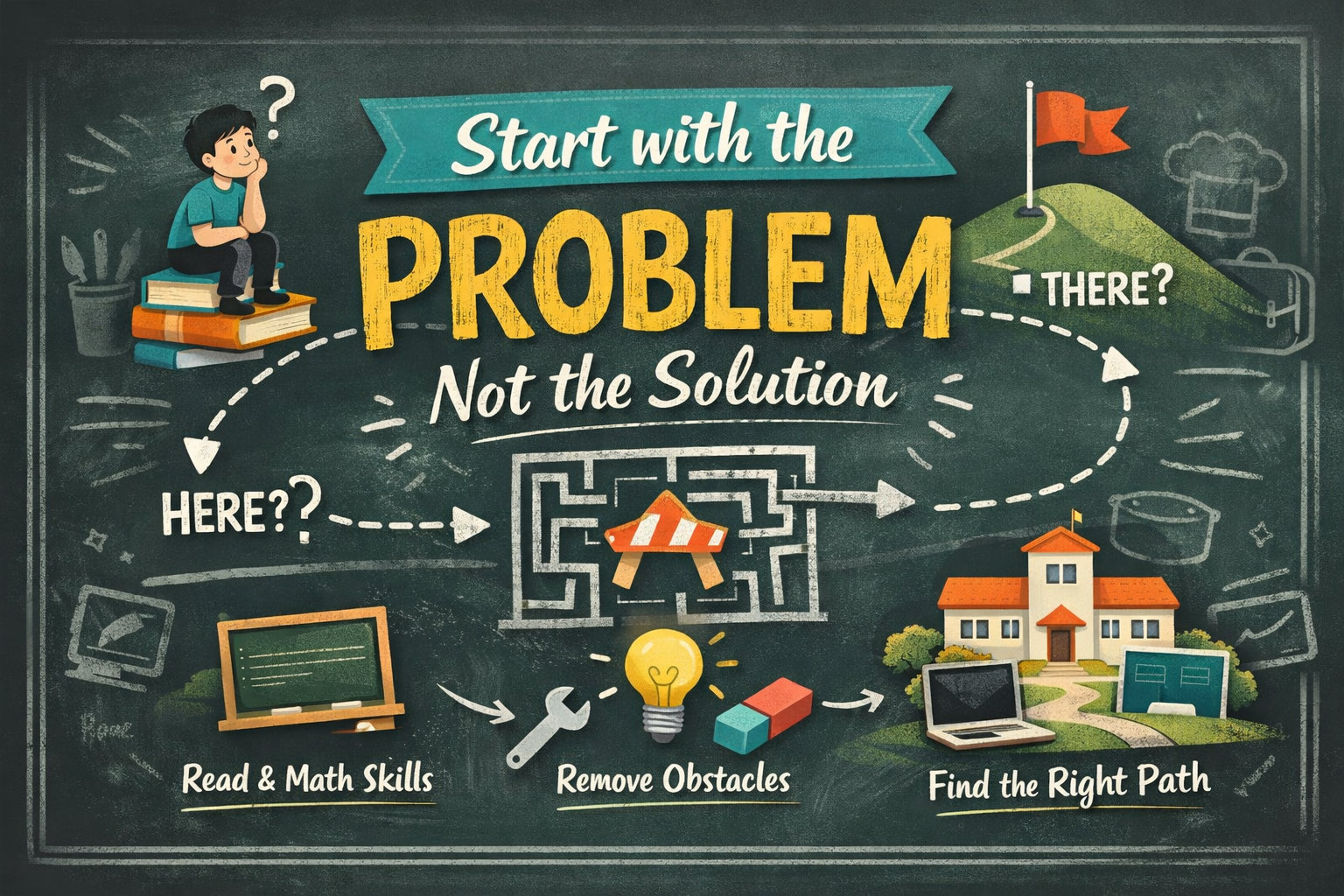
I am here. I want to be there. Something is in the way.
Those “somethings” are the obstacles. If we don’t identify them correctly, we risk choosing solutions that don’t actually move us forward—or that create new problems along the way. This simple framework turns out to be incredibly powerful, especially in education.
How EdOpt Approaches Problem Solving
This way of thinking is foundational to how EdOpt works.
When a family comes to Education Options, whether at a fair or through a consultation, the goal isn’t to push them toward a particular model—public, private, charter, homeschool, microschool, or otherwise. The goal is to help them understand their problem.
That means slowing down and asking questions like:
- Where is this child right now?
- What does the child want?
- What do the parents want for the child?
- What skills does the child already have?
- What skills are missing?
- What obstacles are actually standing in the way?
Only after we answer those questions does it make sense to talk about options. And even then, the approach is iterative. You don’t pick one solution and hope it magically fixes everything forever. You reassess, adjust, and change course if something isn’t working.
That flexibility is one of the biggest advantages of alternative education—but only if good problem solving guides it.
Example 1: Starting With the Basics, Not the Label
Imagine a student who is unhappy in their current school. The temptation is to say, “This school isn’t a good fit—let’s find a different one.”
But EdOpt’s approach asks a more basic question first: Why isn’t it working?
Maybe the child struggles with reading. Maybe math foundations are shaky. Maybe the child already knows much of the material and is disengaged because of being bored. Each of those situations points to a very different obstacle.
If the obstacle is reading, switching schools without addressing literacy won’t help. If the obstacle is boredom, remediation isn’t the answer either.
Once the obstacles are clear, families can choose targeted solutions—extra reading support, a learning center, online coursework, or a different environment altogether—and then reassess once progress is made.
The solution evolves as the child moves from “here” to “there.”
Example 2: Supporting a Student’s Goals, Not Just Seat Time
In another common scenario, a student has a clear interest or goal—say, attending a culinary school—but a traditional school structure is consuming all of their time and energy.
Rather than asking, “Which school should they attend?” the better question is: What does this student need to succeed in the future they want?
That might mean ensuring strong reading and writing skills, bringing math up to speed, and developing organization and self-management skills—all while allowing the student to continue engaging in areas that motivate them.
After some progress, we ask the question again: Where are we now? Where do we want to be next? What obstacles remain? Problem solving becomes a continuous process, not a one-time decision.
Example 3: When Institutions Solve the Wrong Problem
This same framework applies beyond individual families. Institutions fail when they act without clearly understanding the problem they’re trying to solve.
A classic example is when organizations notice declining results—lower engagement, worse outcomes, falling participation—and respond with changes that are only loosely related to the real issue. If the problem isn’t clearly defined, even well-intentioned solutions can make things worse.
Education policy is especially vulnerable to this. When problems are framed around where students are placed instead of what students are learning, the resulting solutions tend to focus on moving students between systems rather than removing the obstacles to learning itself. If a child can’t read, changing the building they sit in doesn’t solve the problem. In some cases, the institution itself may even be part of the obstacle.
The next big thing coming down the pike is open enrollment. If it keeps on its current path, it’ll be another “solution” to a “problem” that isn’t well stated or fully understood. And it could cost a fortune.
This is why EdOpt consistently emphasizes clarity: before launching programs, expanding systems, or declaring solutions, we need to ask the fundamental questions. Where are we now? Where do we want to be? What is actually standing in the way?
Why This Matters for Alternative Education
Alternative education works best when it stays grounded in real problem solving. Not ideology. Not labels. Not one-size-fits-all answers.
Families are different. Kids are different. Obstacles are different.
EdOpt exists to help families see those differences clearly—and to connect them with options that make sense for their specific situation. When we state the problem accurately, the solutions become more obvious, more flexible, and far more effective.
And when we don’t? Even expensive, ambitious solutions can miss the mark entirely.
Getting the problem right isn’t just the first step. It’s the step that determines whether everything that follows actually works.
Spring Fairs
We’re starting to plan EdOpt Fairs for the spring. Look for fairs in Moultonborough, Candia, Goffstown, and other places. Let us know if you want to organize one in your area!
Let your friends know about these fairs. Word of mouth is the best way to advertise. Follow us and share our events and posts on Facebook, Instagram, and X.
Media Appearances
Learn more about EdOpt through our media appearances — recorded interviews and presentations. Some are videos, and some are audio from radio interviews.
Please share them with your friends. Help us spread the word that you have options.
EdOpt’s Goals
EdOpt’s aim is to help families understand all their education options, from non-traditional (homeschooling, homeschool co-ops, microschools) to traditional (charter schools, private schools, tech centers, dual enrollment, learn everywhere). Our website lists the education providers options around the state that we know about (please let us know if we’re missing any!) so you can investigate the ones that you’re interested in. EdOpt also provides guidance to help you understand your options. Set up a FREE Education Options consultation today.
Share this post with your friends.