A couple of years ago at a school board meeting, our principal said that they really don’t know how to teach kids to read. This shocked me. I wrote about it here in a series of 8 articles that explored student reading at schools in the Upper Valley area of New Hampshire and Vermont.
Many teachers were trained to discourage children from sounding out words, the very skill that helps people learn to read — phonics. Sure, English has silent letters and oddly spelled words, but phonics provides the basis for becoming a skilled reader.
No wonder our principal didn’t know how to teach kids to read — she hadn’t learned to use phonics in her own training.
Our superintendent was equally to blame — he brought the Fountas & Pinnell reading program to our small village school a few years prior. He told the school board, of which I was a member at the time, that it was a successful approach because he knew the author from his graduate school days at Teacher’s College in New York. That was good enough for us, but it shouldn’t have been. We should have asked for the research that supported it.
I’m often reminded of this approach to teach reading. Last week, I came across this short video, Why Johnny Can’t Read: Not Enough Phonics. The take-home point is that if your child isn’t learning to read in school, you can help your child learn to read at home.
In fact, it seems that most kids do learn to read at home and not in school. That would explain the lousy test scores we see again and again.
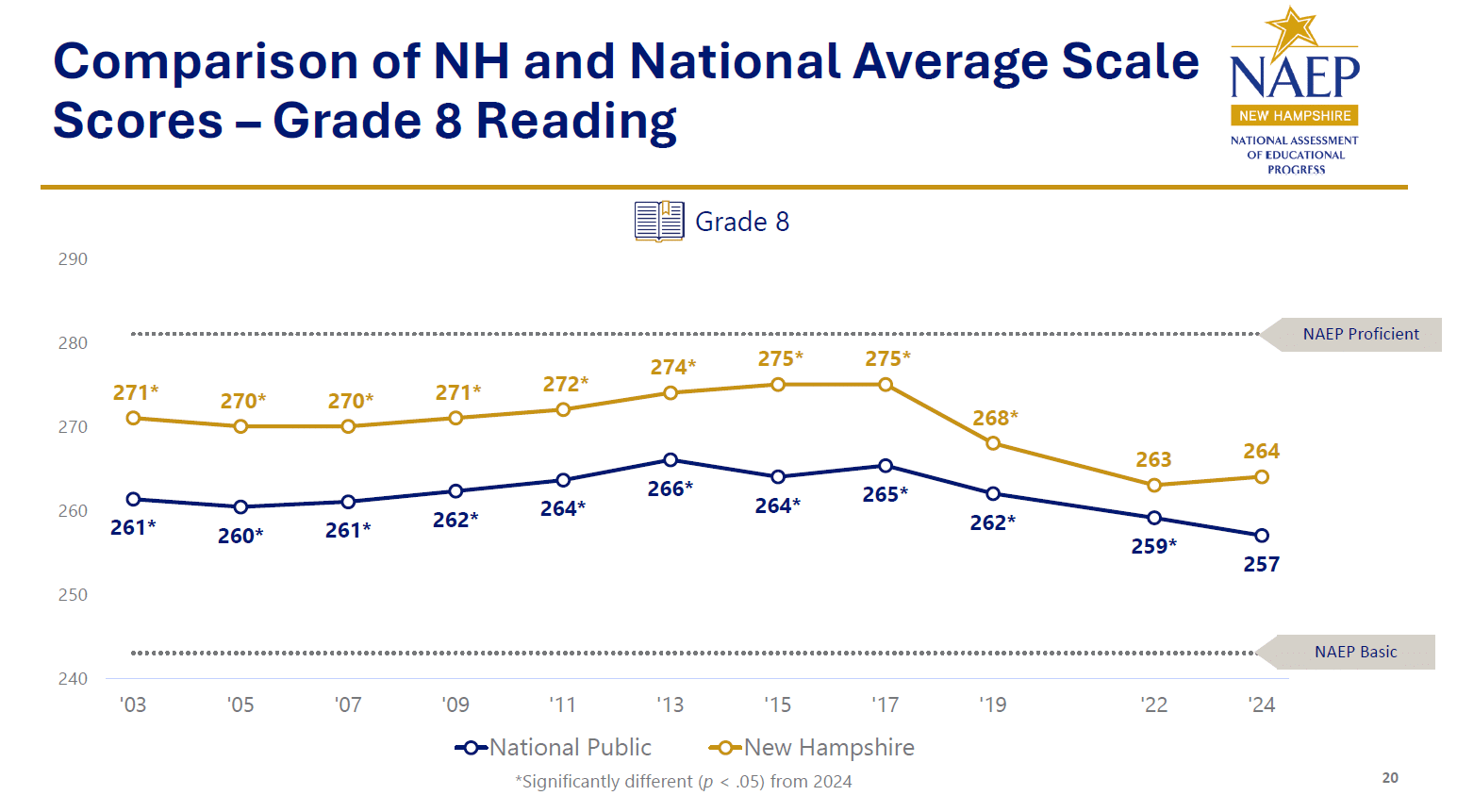
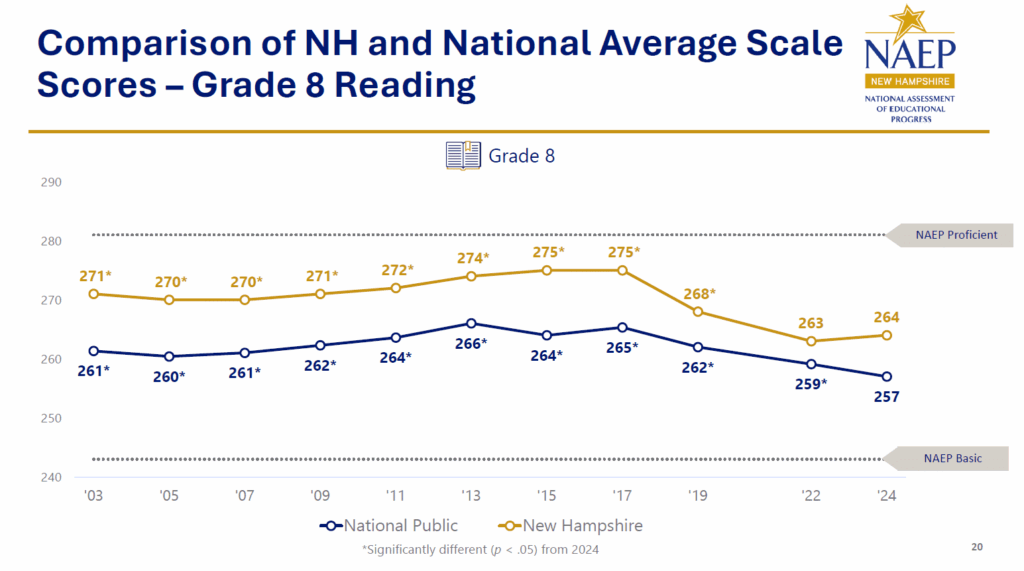
In the chart below, you’ll notice that even though New Hampshire scores better than the national average in 8th grade reading, they have never scored above proficient in at least the last 20 years, and likely longer. You’ll also notice that scores started to drop before the pandemic in 2019.
John Stossel also referred to the Sold a Story podcast, which I came across a few years ago. It was eye-opening. I listened to it twice, all the way through.
“Teaching methods based on this idea can make it harder for children to learn how to read. In this podcast, host Emily Hanford investigates the influential authors who promote this idea and the company that sells their work. It’s an exposé of how educators came to believe in something that isn’t true and are now reckoning with the consequences — children harmed, money wasted, an education system upended.”
Here’s a short Trailer: Sold a Story.
Teach your kids to read. Don’t rely on others to do it. Let us know if you want some guidance.
Media Appearances
Learn more about EdOpt through our media appearances. These are interviews or presentations that were recorded. Some are videos, and some are audio from radio shows.
Please share them with your friends. Help us spread the word that you have options.
EdOpt Fair Schedule
Look for our EdOpt Fairs during National School Choice Week, the last week of January 2026. Our current plan is to have them in Manchester, Dummer, and Claremont.
We’re also starting to plan for the spring. Look for fairs in Nashua, Moultonborough, and other places. Let us know if you want to organize one in your area!
Let your friends know about these fairs. Word of mouth is the best way to advertise. Follow us and share our events and posts on Facebook, too.
EdOpt’s Goals
EdOpt’s aim is to help families understand all their education options, from non-traditional (homeschooling, homeschool co-ops, microschools) to traditional (charter schools, private schools, tech centers, dual enrollment, learn everywhere). Our website lists the education providers options around the state that we know about (please let us know if we’re missing any!) so you can investigate the ones that you’re interested in. EdOpt also provides guidance to help you understand your options. Set up a free Education Options consultation today.
Share this post with your friends.