Before we get to early literacy, we want to announce our first EdOpt Fair of the Spring!
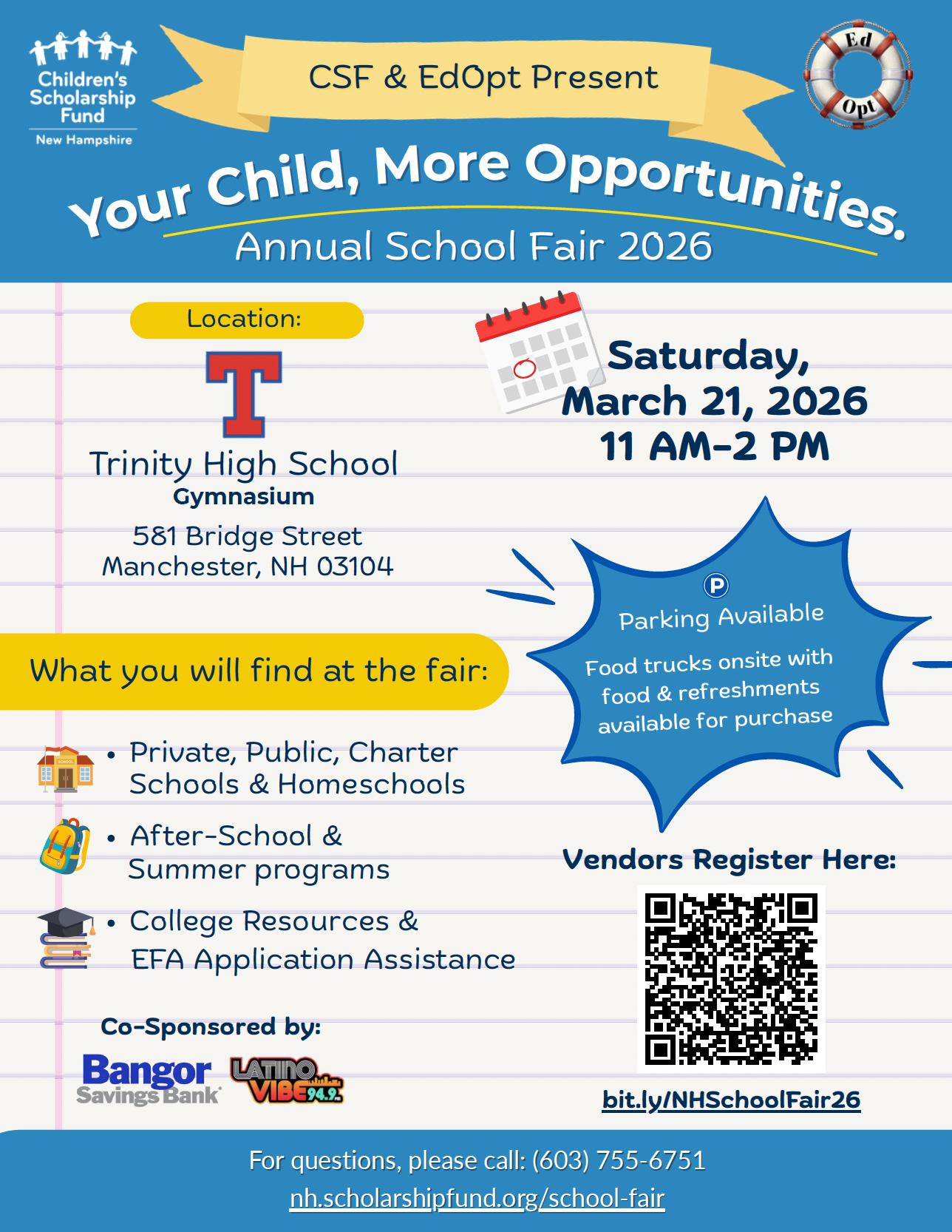
Our first Fair this spring will be next month in Manchester!
EdOpt is partnering with Children’s Scholarship Fund for this Fair. Saturday March 21, from 11-2pm at Trinity High school. We’ll have a DJ and a food truck, and lots of education providers across the range of options.
EdOpt will have a table to help you navigate your education paths.
For more info go here. Education Providers can register at http://bit.ly/NHSchoolFair26.
Nurturing a Love of Reading
Over the last few decades, kindergarten in the U.S. shifted from mostly play + social development toward more teacher-directed literacy and math, more assessment, less free choice time. In a well-known comparison of kindergarten classrooms in 1998 vs. 2010, teachers reported higher academic expectations, more time on advanced literacy and math, and less time on art/music/science and child-selected activities.
The big question is whether that early push—especially in literacy—actually improves long-term outcomes.
What the evidence suggests
- Short-term bumps are common; long-term advantages are inconsistent. In early-education research more broadly, it’s common to see early gains that shrink over time (often called “fadeout”). That doesn’t mean early learning is pointless—it means early gains don’t automatically persist unless later schooling builds on them well.
- “More academics earlier” is not a guaranteed path to stronger readers later. Moving skills earlier can change what kids can do in kindergarten/1st grade without producing a durable advantage years later—especially if the later grades don’t reinforce skills in ways that deepen comprehension, knowledge, and motivation.
So if your goal is a child who can decode early, an academic push may help. But if your goal is a child who becomes a strong, willing reader over time, the research points to a different lever…
The lever that reliably helps: “print exposure” and joyful reading routines
Two research threads are especially useful for parents trying to raise kids who enjoy reading:
1) Kids who are exposed to more reading tend to become stronger readers
A major meta-analysis (99 studies, thousands of participants) found that print exposure / leisure reading is meaningfully associated with outcomes like reading comprehension and technical reading/spelling, and the relationship tends to strengthen across development.
That’s not just “skills practice”—it’s volume, familiarity, and identity (“I’m a reader”).
2) Reading aloud early supports the foundations that make reading easier (and more enjoyable)
Research on early shared book reading links parent reading routines with growth in language and vocabulary, which are key foundations for later reading success—and often for enjoyment, because comprehension makes reading rewarding.
Put bluntly: kids are more likely to enjoy reading when reading works for them—when stories make sense, words feel familiar, and books feel like comfort rather than a test.
New Hampshire “trend reality check”
If the early-academics push were reliably producing stronger long-term outcomes, you’d expect to see steady improvement downstream in broad measures.
One useful downstream indicator is NAEP Grade 4 Reading (not perfect, but stable and comparable over time). New Hampshire remains above the national average, but its Grade 4 reading average is lower in 2024 than it was in 1998.
NH Department of Education’s own summary of recent NAEP results also notes the state’s 4th-grade reading score trend in the last cycle.
This doesn’t prove “academic kindergarten caused the decline.” Lots of forces affect reading (phones, pandemic aftereffects, curriculum swings, attendance, etc.). But it does argue against the simple story that “pushing literacy earlier” has clearly solved the problem.
Let’s beat the odds: a parent playbook for raising a reader
Your edge is motivation + exposure + relationship.
1) Make reading a daily ritual, not a performance
- 10 minutes counts.
- Let the child choose (even the same book every night).
- If they wiggle, keep going anyway—wiggly listening still builds language.
2) Re-read favorites on purpose
Re-reading is not “stagnation.” It’s how kids build fluency, vocabulary, and confidence.
3) Talk around books (this is the cheat code)
Two minutes of chat can do more than five minutes of “sound it out.”
- “Why do you think he did that?”
- “What would you do?”
- “What do you think happens next?”
This grows comprehension and makes books feel social.
4) Protect pleasure reading from school pressure
If school sends home leveled readers that feel like work:
- Do the minimum required.
- Then read something fun that restores the emotional balance.
5) Build a “book-rich environment” without making it precious
Easy access beats expensive shelves:
- library trips
- basket in the living room
- a few books in the car
- comics, magazines, manuals, cookbooks—anything counts
This aligns with the “print exposure” evidence: more everyday contact with text adds up.
A closing thought for parents
The goal isn’t to “win” kindergarten.
The goal is a 10-, 14-, 18-year-old who can pick up a text, make meaning, and want to keep going. The research is pretty clear: joyful exposure and language-rich routines are a better bet for that long game than simply pushing harder, earlier.
Spring Fairs
Our first Fair this spring will be in Manchester! EdOpt is partnering with Children’s Scholarship Fund for this one. Saturday March 21, from 11-2pm. We’ll have a DJ and a food truck, and lots of education providers across the range of options. EdOpt will have a table to help you navigate your education paths. For more info go here. Education Providers can register at http://bit.ly/NHSchoolFair26.
Candia and Goffstown Fairs will each take place in May. Stay tuned for final dates and locations.
We’re working on other fairs as well. Let us know if you want to organize one in your area!
Let your friends know about these fairs. Word of mouth is the best way to advertise. Follow us and share our events and posts on Facebook, Instagram, and X.
Media Appearances
Learn more about EdOpt through our media appearances — recorded interviews and presentations. Some are videos, and some are audio from radio interviews.
Please share them with your friends. Help us spread the word that you have options.
EdOpt’s Goals
EdOpt’s aim is to help families understand all their education options, from non-traditional (homeschooling, homeschool co-ops, microschools) to traditional (charter schools, private schools, tech centers, dual enrollment, learn everywhere). Our website lists the education providers options around the state that we know about (please let us know if we’re missing any!) so you can investigate the ones that you’re interested in. EdOpt also provides guidance to help you understand your options. Set up a FREE Education Options consultation today.
Share this post with your friends.