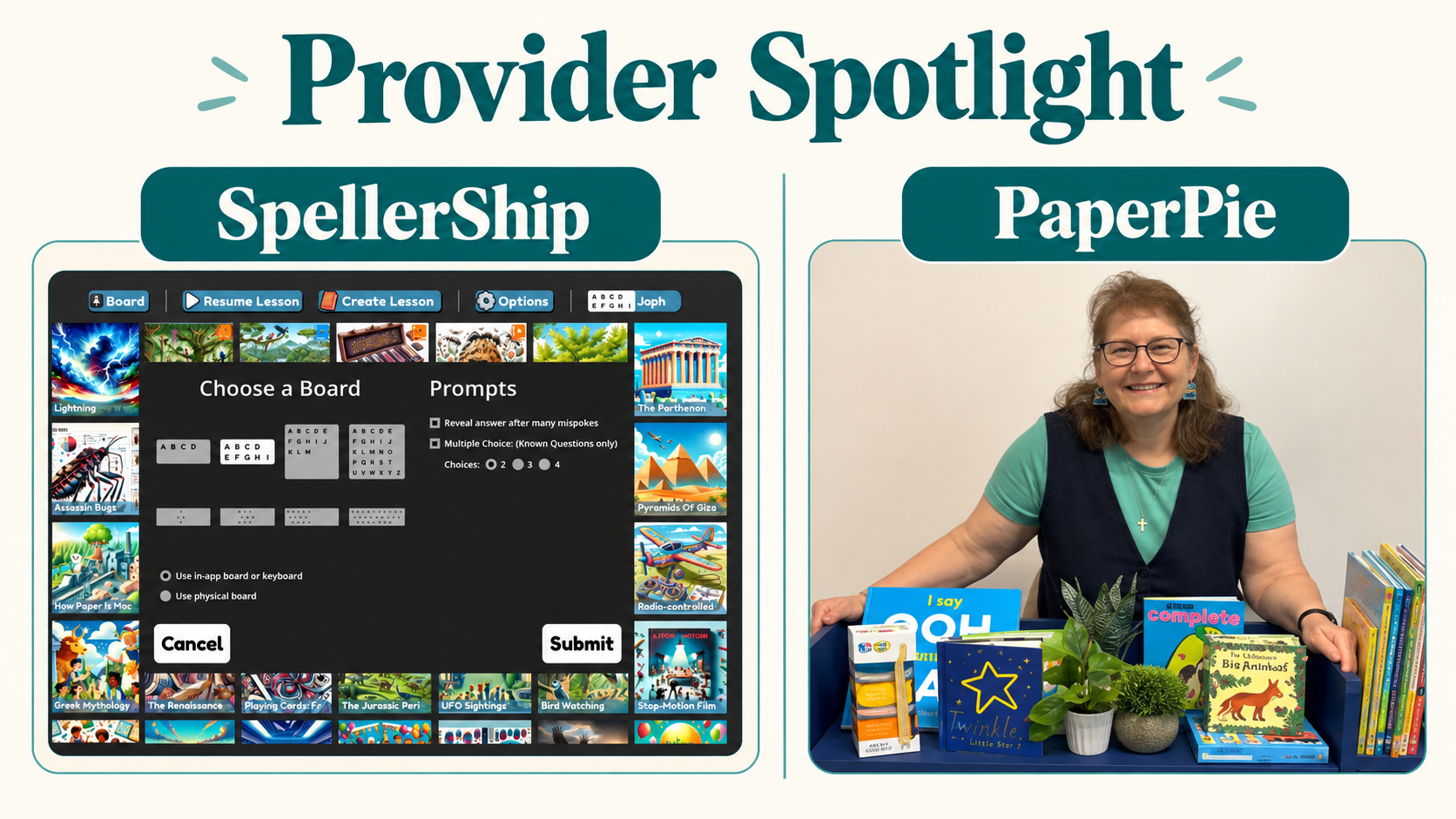
I recently learned about two New Hampshire education providers whose personal experiences with autism shape their work. Their stories and approaches are different, but both help families find learning tools that fit their children.
If you know a family with a nonspeaking child — or anyone looking for more flexible learning options — please share these spotlights with them.
–Jody
Jody Underwood, Ph.D.
President, Education Options
[Share this newsletter with a friend who would be interested.]
Stay tuned for fairs during National School Choice Week in January 2027! We have our eyes on Claremont and Milton. Let us know if you want to help in any way.
PROVIDER SPOTLIGHT 1
Reading, Spelling, and Real Thinking, One Lesson at a Time
SpellerShip began at a New Hampshire family’s kitchen table. A father whose nonspeaking son communicates by spelling needed learning materials that fit his child. When existing options fell short, he built his own — and then shared it with other families.
Today, SpellerShip offers more than 1,000 ready-made lessons combining reading comprehension, spelling, and original thinking. Designed first for nonspeaking learners, it includes material for children just learning their letters through teenagers and adults. The founder still uses it with his son and personally answers support emails.
For homeschooling families, it’s a familiar story: finding a way to make learning fit the child.
Read, Spell, and Reflect
Each lesson covers a topic through seven short passages. Students read or listen, then answer questions before moving on. The questions vary as they check comprehension and spelling, with open-ended prompts inviting answers in the child’s own words.
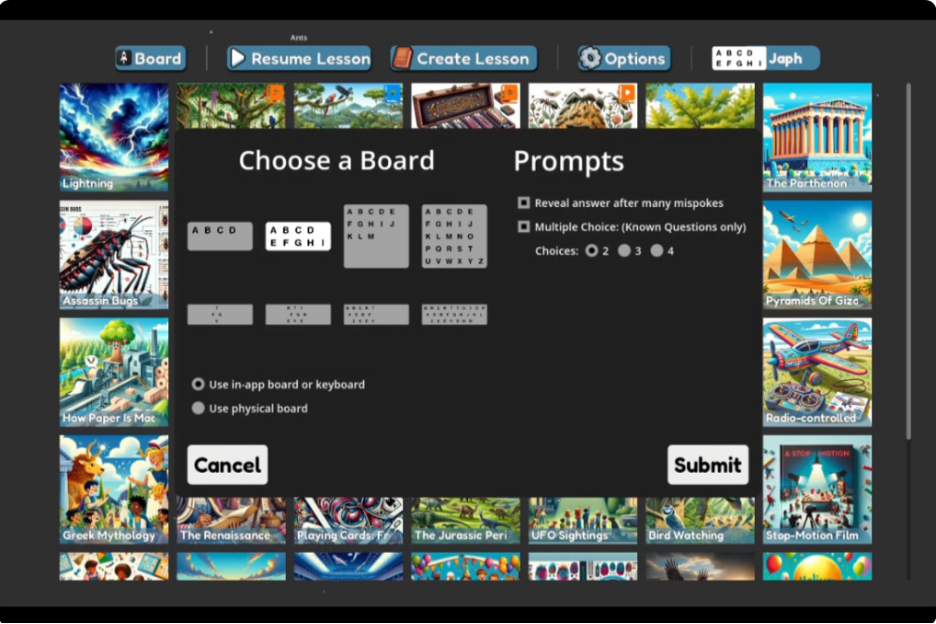
Parents control the difficulty. They can set how many multiple-choice answer choices the app displays (2, 3, or 4) or turn choices off so students spell their answers without hints. That flexibility lets siblings explore the same subject with different levels of support.
Topics span science, history, geography, literature, animals, holidays, and more. A younger learner might study farm animals while an older sibling explores World War I. Families can connect lessons to a unit study or follow a child’s latest fascination.
With a paid subscription, parents can also generate complete lessons on topics of their choosing — from octopuses to the American Revolution or the Flume Gorge before a family outing.
Options That Fit the Learner
SpellerShip’s roots in nonspeaking education shape its features. Families using spelling-based approaches such as Spelling to Communicate (S2C), Rapid Prompting Method (RPM), or the Spellers Method can access lessons at home, especially if nearby practitioner support is limited.
On-screen letterboards can display 4, 8, 13, or all 26 letters to match a learner’s motor practice. The app also offers different keyboard layouts and an option to use a physical board. These settings help families adapt how students participate, while open-ended questions provide room to express their ideas.
Want to see the options in action? This video walkthrough explains the app’s features. At a little over seven minutes, it’s worth watching if SpellerShip looks interesting to you.
Try It Free
SpellerShip works on iPhone, iPad, Android phones and tablets, and in a web browser on a computer. Families can try a selection of lessons and question features for free; a paid subscription unlocks the full library and custom lesson creation – type in the topic and SpellerShip builds a full seven-passage lesson with reading, questions, and spelling built in. For a family following the child’s interests, this is powerful. Check out a sample lesson about the Flume Gorge.
There’s nothing to print — just an opportunity to explore a subject together, practice spelling, and hear what a learner thinks.
Learn more at spellership.com.
[If you like this article, please share it with a friend.]
PROVIDER SPOTLIGHT 2
PaperPie and Meeting People Where They Are
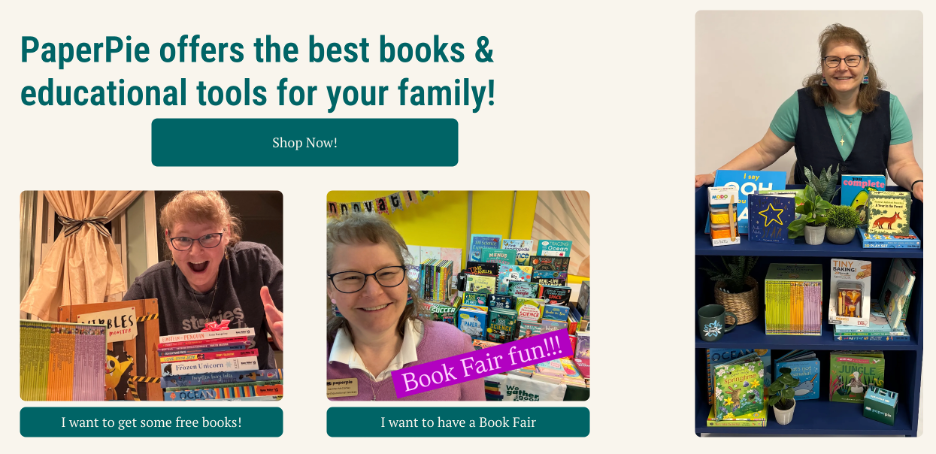
I’m not an expert on autism or special needs. But I have twenty years of experience helping families find books and educational tools that meet their children’s needs — and personal experience with how differently those needs can look.
My husband, a (literal) rocket scientist, has never been formally diagnosed with autism, but we suspect he has it. Over the years, we’ve built a family life that accommodates his needs. Our home has always been quiet, even with two boys. Sensory issues influence which meals I prepare, and during disagreements, my husband can’t look at me.
Our experience is very different from my neighbor’s. Her autistic son has attended a specialized school since he was four and may need lifelong support from his family.
These experiences have reinforced something that guides my work: no two people have exactly the same needs. Educational materials should reflect that.
Finding the Right Fit
Through PaperPie, I help families choose books and educational tools based on where their children are now and what they’re ready to explore next.
Does your family need a book to help a child understand an autistic cousin? Is your child eager for material beyond their grade level? Would a book about visiting the doctor or dentist make an unfamiliar experience feel more comfortable? Are you looking for ways to explore new textures?
These are the kinds of questions I help parents work through. A child’s age or grade offers a starting point, but their interests, abilities, and comfort matter too. The goal is to find materials that invite them into learning and support their next steps.
That approach matters whether a family is navigating sensory differences, looking for an academic challenge, or simply trying to find a book that sparks a child’s curiosity.
Reading Together at Every Age
One recommendation I return to often is reading aloud — even after children can read independently.
Sharing a book creates time for connection while introducing vocabulary, encouraging imagination, and opening conversations. It also gives children access to ideas and stories they may understand and enjoy before they can comfortably read them on their own.
For parents, it’s an opportunity to follow a child’s interests, explore something new together, and make learning part of everyday family life.
Meeting children where they are means noticing what helps them participate and giving them tools to keep growing. That’s also why I appreciate EdOpt’s mission: access to different educational options helps families find what fits.
To explore PaperPie’s books and learn how I serve families and organizations, visit WonderFunBooks.com.
Happy reading!
Choosing School podcasts
Go to our Choosing School playlist:
- Episode 4: Why We Chose Differently. Jody speaks with Robert Qua, former Special Ed Director, why he left the school system; Jaime Koladish, Founder of Benjamin Franklin Academy, why she started a charter school; Frank Edelblut, former Commissioner of the NH Department of Education, why he homeschooled all his kids. The conversation takes off from there.
- Episode 3: Special Needs, Different Paths. A conversation with Bob, a former special education director, and two parents, Viviana and Brandon, who each support their child’s unique paths.
- Episode 2: Moms Who Started Microschools in NH. Three unique moms with different yet related stories: Kitty at Latitude Learning Center in Derry, Dianna at The Learning Cove in Bow, and Heather at Wildcat Microschool in Haverill.
- Episode 1: The Many Paths of Homeschooling. Katy (10 and 12 year-old kids), Kristi (3, 6, 9, 10 yos), and Mari (14 yo) talk about how they support their children through different types of schooling, including home education.
[If you like these podcasts, please share them with a friend.]
A Little About EdOpt
Use our website to find education providers options around the state. If your organization isn’t there, please enter it!
Also check out our AI Assistant, the EdOpt Navigator, available on every page on our website. It’s wicked smaht about education in New Hampshire.
[If someone forwarded this post to you, please consider subscribing to EdOpt.]