This Thanksgiving, I’m thankful for the parents and educators who refuse to give up when a child is struggling. Sometimes the answer isn’t to change the child. It’s to change the environment in which the child learns.
-Jody
QUESTIONS WORTH ASKING
What If the School Is the Problem?
When children struggle, or stop being challenged, sometimes a different learning environment makes all the difference.
What if a child who needs an Individualized Education Program (IEP) in one school doesn’t need one in another?
That’s what Jaime Koladish, a founder of Benjamin Franklin Academy, a public charter school in Loudon, New Hampshire, reported during an episode of EdOpt’s Choosing School podcast.
“We have multiple students at Benjamin Franklin that don’t have their IEPs anymore,” she said.
Former special education director Robert Qua described similar experiences: children struggling in district schools who moved to another educational environment and no longer needed the same supports.
What changed? Did their learning difficulties disappear? Or was the original environment contributing to those difficulties?
It’s a question worth asking.
Four Children, Different Needs, Different Solutions
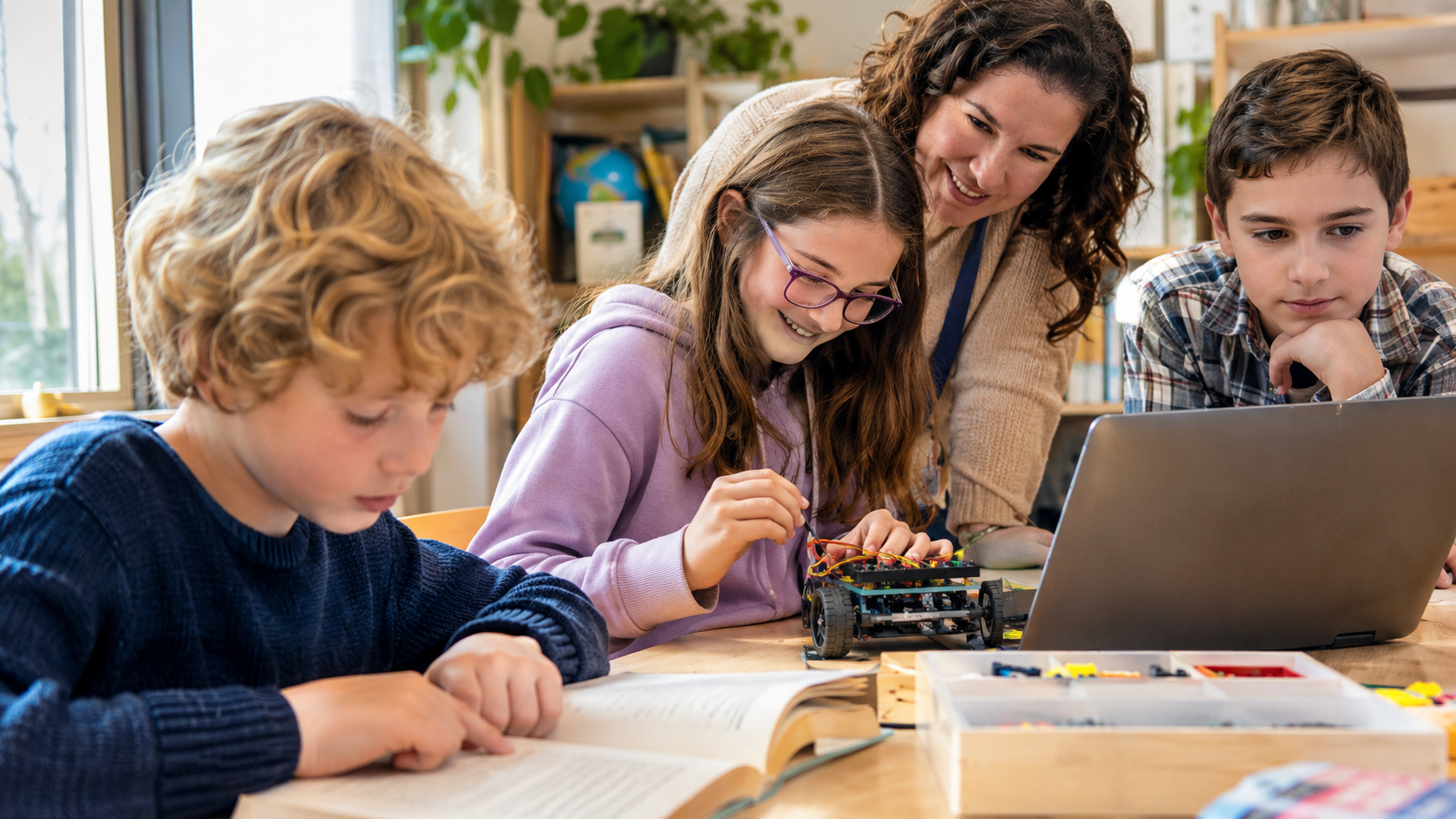
In two episodes of Choosing School, parents and educators shared experiences that suggest an important possibility: sometimes changing the educational environment changes everything.
Viviana’s son needed a different approach to communication.
He attended a public-school early-childhood program, where his parents saw some progress but felt he needed more. A private speech therapist subsequently identified differences in how he processed language that was not determined in his IEP. With individualized speech, occupational, and physical therapy — and changes in how his family communicated with him — Viviana reported remarkable improvements.
Her son hadn’t changed. The adults had learned how to communicate with him differently.
Brandon’s daughter needed individualized attention.
She struggled with transitions, time management, and emotional regulation. Her family chose a small private Christian school, where a classroom of approximately 11–12 students, supported by a teaching assistant, allowed teachers to work closely with her. Brandon described how much the personal attention and regular communication between teachers and parents even helped her behavior at home.
Jaime saw children succeed in a different public-school model.
At Benjamin Franklin Academy, some students who previously had IEPs no longer have them. That doesn’t necessarily mean their disabilities disappeared. But it raises questions about how much a school’s structure and instructional approach affect a child’s need for accommodations.
Emma needed more challenge, not more remediation.
Her parents described a gifted child who became frustrated and developed behavioral difficulties when schoolwork failed to challenge her. Even an IEP that included enrichment didn’t resolve the problem. After transferring to a charter school, she was placed in a higher-grade classroom because of her skill level, and her parents reported that her behavior improved dramatically.
As Emma’s family put it: “Nothing about our daughter had changed. What changed was the environment around her.”
These four families chose different solutions: specialized therapy and homeschooling, private school, and public charter schools. What connects their experiences isn’t the type of school. It’s finding an environment that fits the child.
Is the Problem the Child—or the Environment?
Most conventional schools organize children by age, teach them on similar schedules, and expect them to progress through material at roughly the same pace.
That works for many children. But what happens to the child who needs more time to master reading? The child overwhelmed by a busy classroom? The child who understands the material immediately and spends the rest of the lesson waiting?
We often respond by identifying a problem with the child and adding services or accommodations. Sometimes those services are exactly what’s needed. But sometimes we should also ask whether the environment itself needs to change. As was mentioned in Episode 4 of Choosing School, children shouldn’t be treated as if something’s wrong. They just learn and interact differently.
A child’s disability may be real, yet its impact on learning can vary dramatically depending on the setting. And as Emma’s experience illustrates, children without learning disabilities can also struggle when their educational needs aren’t being met.
What Does the Research Tell Us?
The 2026 American Microschools Sector Analysis found that 80% of surveyed microschools serve neurodivergent students, while 56% serve children with other special needs. Those percentages describe schools serving such children, not the proportion of students with disabilities.
A separate study, Measuring the Microschool Experience, found generally expected academic growth among participating students, alongside high levels of reported safety, belonging, and satisfaction.
This research reinforces a question raised by the families’ stories: Could smaller, more flexible learning environments help some children succeed?
Different Doesn’t Always Mean Better
Changing learning environments isn’t a universal solution, but it could help.
Some children need specialized instruction, therapies, equipment, or services that smaller schools cannot provide. District schools are required by law to provide such services. But that doesn’t mean that private schools and homeschooling arrangements do not provide support.
And an IEP disappearing isn’t necessarily evidence that a child no longer needs support. What matters is whether the child is learning, developing, and receiving appropriate help.
Robert Qua, who spent years working in public-school special education, emphasized that district schools are full of dedicated professionals who care deeply about children. The issue isn’t necessarily the people working in those schools. It’s whether a particular educational environment works for a particular child.
What Should Parents Ask?
If your child is struggling — or isn’t being challenged — consider asking a different set of questions.
Is the instruction appropriate? Is the pace right? Is the classroom environment helping or hindering learning? Are the available services producing meaningful progress?
And perhaps most importantly: Would my child do better somewhere else?
New Hampshire families have options outside of district schools, including charter schools, private schools, microschools, homeschooling, and hybrid approaches. EdOpt helps families explore those possibilities and find environments that better fit their children.
The question isn’t whether public schools or alternative schools are better.
They question is why we expect such different children to succeed in the same educational environment, and what becomes possible when we stop expecting them to.
Explore more family experiences in EdOpt’s Choosing School podcast and Emma’s Story. Join our new Facebook group to share your stories and to get help with your challenges.
[Share this newsletter with a friend who would be interested.]
Stay tuned for fairs during National School Choice Week in January 2027. We have our eyes on Claremont and Milton, and Children’s Scholarship Fund & EdOpt will be co-hosting a fair at the Grappone Center on Saturday, January 30, where many providers will have tables while there will be children’s activities — fun for the whole family. Let us know if you want to help in any way.
Choosing School podcasts
Check out our Choosing School podcasts:
- Episode 4: Why We Chose Differently. Guests include Frank Edelblut, former Commissioner of the NH Department of Education; Robert Qua, former Special Ed Director in NH public school districts; and Jaime Koladish, founder of Benjamin Franklin Academy Charter School.
- Episode 3: Special Needs, Different Paths. A conversation with Bob, a former special education director, and two parents, Viviana and Brandon, who each support their child’s unique paths.
- Episode 2: Moms Who Started Microschools in NH. Three unique moms with different yet related stories: Kitty at Latitude Learning Center in Derry, Dianna at The Learning Cove in Bow, and Heather at Wildcat Microschool in Haverill.
- Episode 1: The Many Paths of Homeschooling. Katy (10 and 12 year-old kids), Kristi (3, 6, 9, 10 yos), and Mari (14 yo) talk about how they support their children through different types of schooling, especially home education.
[If you like these podcasts, please share them with your friends.]
A Little About EdOpt
Use our website to find education providers options around the state. If your organization isn’t there, please enter it!
Also check out our AI Assistant, the EdOpt Navigator, available on every page on our website. It’s wicked smaht about education in New Hampshire.
[If someone forwarded this post to you, please consider subscribing to EdOpt.]